
'Hit' Music: 4J's Radio Station Navigates Funding Loss

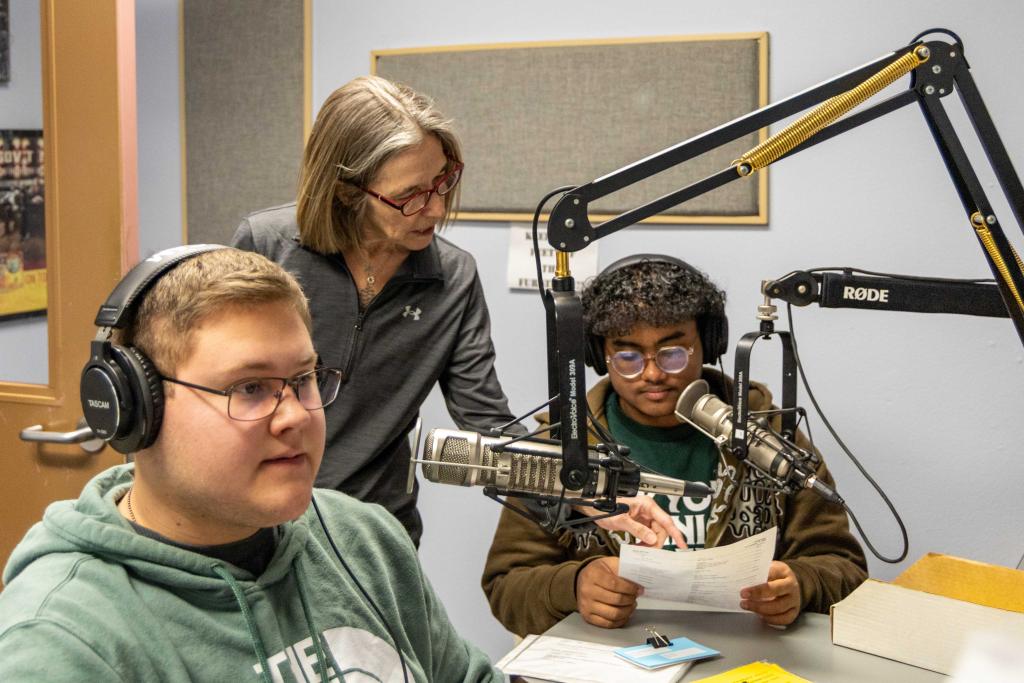
As it launches its first membership drive of the year during the week of March 23, KRVM-FM is facing a new reality: the public radio station licensed to Eugene School District 4J is now entirely dependent on listener support.
KRVM lost one-fifth of its annual operating dollars, or about $186,000, when federal grant funding through the now-defunct Corporation for Public Broadcasting ended. 4J does not provide any funding to KRVM, but it does provide the station its studio space and holds its federal broadcasting license.
 “Everything that keeps this radio station going is now going to have to come from the local area,” General Manager Stu Grenfell said.
KRVM already has made up roughly three-quarters of the lost federal funding from increased listener support, with more than three months left in the budget year. But a lull in that financial backing risks shrinking KRVM’s coverage area, which spans from the coast to the mountains, Florence to Oakridge. Leases of the auxiliary radio towers that retransmit KRVM’s signal far and wide are one of its largest annual expenses. A primary purpose of the federal funding was to ensure rural communities – which typically have populations too small to be profitable for commercial radio stations – have coverage to receive emergency alerts and timely community information.
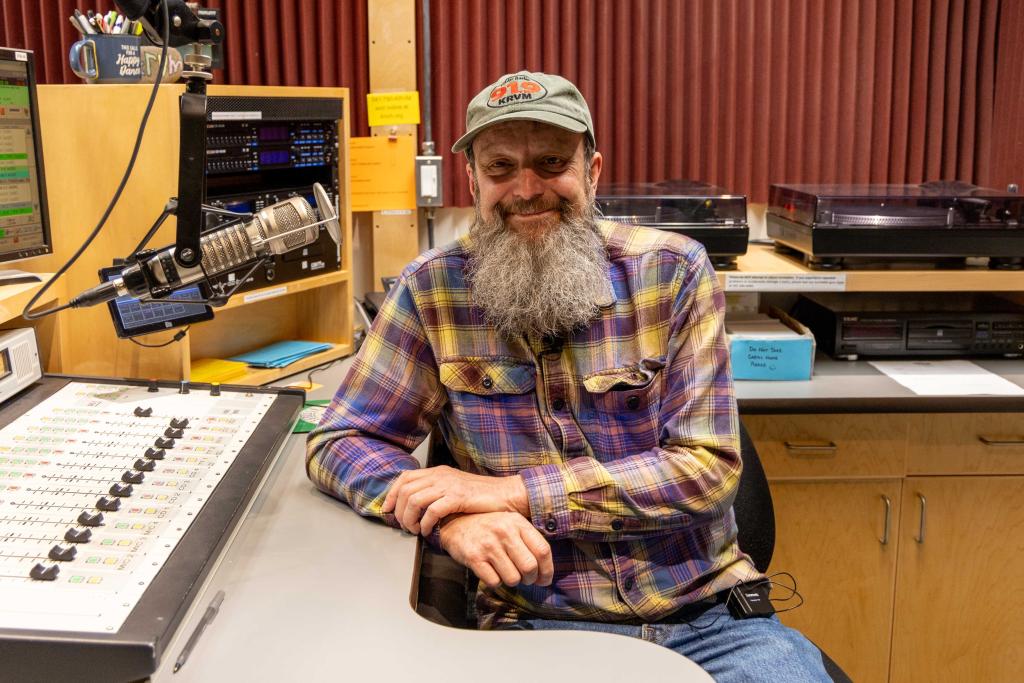
General Manager Stu Grenfell said he’s grateful
for the community support KRVM has received since it lost its federal funding. |
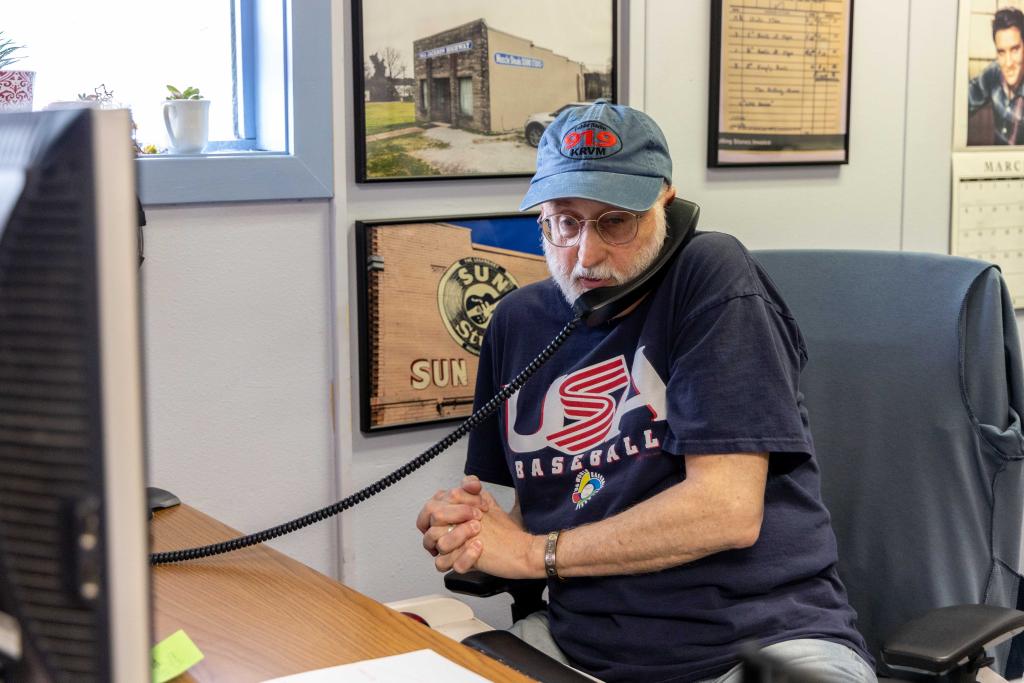
Development Director Jim Nelson talks on the phone
at the KRVM studio. |
The KRVM studio has been located
at Sheldon High School since 1992. |
Keeping paying listeners and local businesses in tune with KRVM will be a marathon, not a sprint, for the 78-year-old radio station located at Sheldon High School. To make up the lost federal fundiing each year, KRVM figures it needs 15 percent of its listenership to provide financial support when less than 10 percent do so now. Grenfell remains confident, however, that a strong community of listeners can preserve the radio station’s reach and programming made possible entirely by 4J high school students and volunteer disc jockeys.
Part Classroom, All Radio Station
Students enrolled in Sheldon’s two radio broadcasting classes pre-record the segues, public announcements and member thank-yous, with their recordings airing between the songs that KRVM plays during the workday.
The arrangement stays true to KRVM’s legacy as the first non-commercial educational radio station in the Pacific Northwest. The school district and Eugene Vocational School – the predecessor of Lane Community College – brought the radio station to life on Dec. 6, 1947, to provide training for high school students interested in careers as broadcasters and audio technicians. They produced educational and informational programs broadcast through loudspeakers installed in the elementary and middle school classrooms.
Nearly 80 years later, KRVM’s standing as part of the classroom still holds. In addition to learning to operate a soundboard or properly enunciate a difficult last name, today’s students learn valuable “soft skills” that include working together as a team and honing their speaking in public.
“You can’t just speak casually on the radio,” said Fateen Anto, a Sheldon sophomore who’s an exchange student from Bangladesh. “I have to speak professionally, like something’s important.”
Debi Starr, KRVM’s program coordinator who’s had a decades-long career in local radio, said being able to impart her knowledge to a younger generation about speaking to a large audience “is kind of a dream come true that you didn’t know you had.”
“Especially, with the kids that are a little shy in the beginning, I like to show them how much they’ve improved but also to just say, ‘Now when you have to talk to a group of 30 people in a class or 100 people in an assembly, remember, you’ve already talked to 2,000 people,’ just to kind of remind them about the experience they’re getting,” Starr said.
The studio work also brings together students from different walks of life who may not typically socialize or even interact in class.
“It’s kind of hard to be stuck in a soundproof room with a bunch of other kids and not get along,” Sheldon senior Morgen Lemke said. “We get to learn a lot about each other here.”
On weekday evenings and weekends, the radio station relies on its dedicated and eclectic roster of more than 30 volunteer disc jockeys, who bring lesser-known musical genres and deep cuts from well-known acts to the fore: world music, swing, Celtic, the Beatles and the Grateful Dead, to name a few. Some have been heard on KRVM’s airwaves for decades.
“Jivin’” Johnny Etheredge began his radio career at KRVM more than a half-century ago. A former KRVM program manager who started at the radio station when it aired only six days a week and as little as eight hours a day, Etheredge currently hosts six shows that showcase musical genres outside the mainstream. He produces his shows in real time because he enjoys listening to the music so much.
“Who else in this town is playing Hank Williams or Bob Wills? Nobody. Who else in this town is playing early rhythm and blues and rock and roll? Nobody. It’s part and parcel of public radio being able to serve diverse audiences,” said Etheredge, a retired educator.
He added: “I’ve had people tell me, ‘Johnny, I moved away and lost track of KRVM for a while, and I was following the McKenzie River into Eugene, and as soon as I picked up KRVM on the radio dial, I knew I was home.’”
‘We’re Going to Make Sure You Stay Here Forever’
The radio station provides other essential public services to Eugene and surrounding communities. It has broadcast 4J school board meetings and school closures and delays for decades. As part of the national public warning system, it has delivered critical and life-saving information in emergencies. On a single day in September 2020, for example, the radio station broadcast 38 evacuation alerts as the devastating Holiday Farm Fire swept through the McKenzie River valley.
“There was no cell service out there. There was no internet service out there. It all burned up. The only way people knew they needed to evacuate, the only source of information they had, was our station and one other,” Grenfell said.
The radio station connected the community during the coronavirus pandemic, even when volunteers couldn’t step foot in the studio due to social distancing requirements.
“Volunteers were recording their breaks on their phones at home and emailing them to us and sending us a list of the songs they wanted to play. We spent hours and hours and hours in the production studio, assembling these things into shows that sounded like regular shows,” Grenfell recalled.
The response from listeners was immediate and overwhelming.
“We had people just calling us and thanking us all the time, saying ‘You’re the only normal thing in my life right now. I know I can count on you,” the general manager said.
Six years later, the script has flipped, in a way. Just as listeners had counted on KRVM for support and stability during a rough period, the radio station is now counting on its listeners for much the same. Grenfell remains optimistic that financial support will continue, recalling vividly the initial response from the community after learning the federal funding was going away.
“It was astounding to me, within the first day or two, how many people called and said, ‘We’re not gonna let them take this away from us. We are going to make sure you stay here forever.”