
Curriculum and Standards
Curriculum and State Standards
The 4J Instructional Services Department is committed to offering rigorous and engaging academics that meet the state’s grade level and content standards. Our goal is to provide every student with curriculum and learning materials that facilitate relevant education, equipping them with the skills to navigate current and future challenges, while also fostering robust opportunities for self-discovery. For detailed curriculum information, please click the links below.
General Inquiries: email instruction@4j.lane.edu or call 541-790-7550
 Elementary School Standards, Curriculum and Instructional Materials
View current state standards of education and learning materials for students in Kindergarten through Grade 5.
Subjects: Language Arts, Health, Mathematics, Library, PE, Science and Social Studies
 Middle School Standards, Curriculum and Instructional Materials
View current state standards of education and learning materials for students in Grades 6-8.
Subjects: English Language Arts, CTE, Health, Mathematics, Music, PE, Science, Social Studies, World Language, Dual Language Immersion, Social Emotional Learning & Other, Library
 High School Standards, Curriculum and Instructional Materials
View current state standards of education and learning materials for students in Grades 9-12.
Subjects: English Language Arts, CTE, Health, Mathematics, Music, PE, Science, Social Studies, World Language, Dual Language Immersion, Social Emotional Learning & Other, Library
Math Curriculum Adoption Update
4J is currently conducting pilots of math materials ahead of adopting a new curriculum for the 2025-2026 school year. Parents, students, and community members have a voice in this important process.
During the 2023-24 academic year, a group of nearly 90 teachers and teacher leaders engaged in our review process. This began with developing a shared understanding of the new vision of math instruction outlined by the Oregon Math Project. This includes a major shift from a focus on procedural skills to focusing on a deep, coherent, conceptual understanding of math ideas. Also, the Oregon Math Project outlines 3 major math pathways for students after middle school (Data reasoning, Calculus, and Quantitative Reasoning). This creates an exciting call to action for 4J to have an articulated sequence of learning and guaranteed high-quality curriculum for all students K-10 so that they can be well prepared for whichever pathway they take.
After the shared learning about the vision, the review team used nationally-vetted curriculum review criteria and resources, including the Instructional Materials Evaluation Tool (IMET), Culturally Responsive Curriculum Scorecard to create a curriculum review tool to evaluate 4-5 sets of materials at each level that were highly rated by EdReports, a nationally recognized non-profit that is designed to improve K-12 education through the evaluation of instructional materials.Then, the team selected two curricula for K-5, 6-8, and 9-10 math that are aligned to ODE Math standards, reflect 4J’s commitment to culturally responsive practices, and are aligned to the shared vision of math instruction.
The two curricula to pilot each in elementary, middle, and high school classrooms are:
- Elementary School (grades K-5): Bridges in Mathematics 3.0 and Illustrative Math v360
- Middle school (grades 6–8): i-Ready Math and Midschool Math
- High School (grades 9–10): Illustrative Math and Open Up High School Mathematics
After piloting those programs in 2024-25, the team will make a final recommendation for adoption.
High Level Adoption Timeline
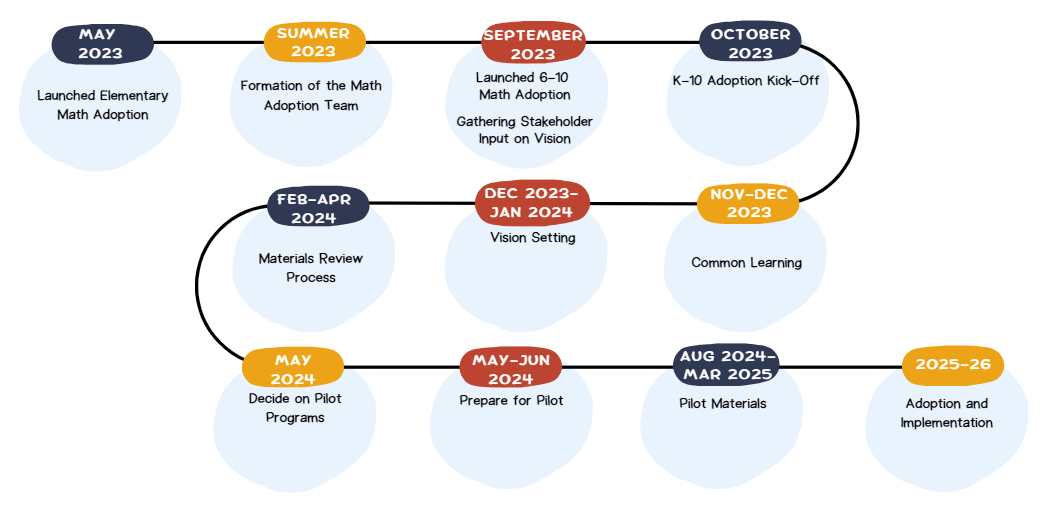
The adoption team has created a video detailing the adoption process and the curriculum suites under consideration. You’re invited to provide feedback using an online form after watching the video.
Actualmente, el 4J está realizando pruebas piloto de materiales de matemáticas antes de adoptar un nuevo currículo para el año escolar 2025-2026. Los padres, estudiantes y miembros de la comunidad tienen voz en este importante proceso.
Durante el año académico 2023-24, un grupo de casi 90 maestros y líderes docentes participaron en nuestro proceso de revisión. Esto comenzó con el desarrollo de una comprensión compartida de la nueva visión de la enseñanza de las matemáticas delineada por el Proyecto de matemáticas de Oregón. Esto incluye un cambio importante de enfoque en las habilidades procedimentales a un enfoque en una comprensión conceptual, profunda y coherente de las ideas matemáticas. Además, el Proyecto de Matemáticas de Oregón describe tres vías principales de matemáticas para los estudiantes después de la secundaria (razonamiento de datos, cálculo y razonamiento cuantitativo). Esto crea un emocionante llamado a la acción para que el 4J tenga una secuencia articulada de aprendizaje y un currículo garantizado de alta calidad para todos los estudiantes K-10 para que puedan estar bien preparados para cualquier camino que elijan.
Después del aprendizaje compartido sobre la visión, el equipo de revisión utilizó criterios y recursos de revisión del currículo examinados a nivel nacional, incluyendo la Herramienta de evaluación de materiales educativos (IMET) y el Cuadro de mando del currículo culturalmente receptivo para crear una herramienta de revisión del currículo para evaluar 4 o 5 conjuntos de materiales en cada nivel que fueron altamente calificados por EdReports, una organización sin fines de lucro reconocida a nivel nacional que está diseñada para mejorar la educación K-12 a través de la evaluación de materiales educativos. Luego, el equipo seleccionó dos currículos para matemáticas K-5, 6-8 y 9-10 que están alineados con el estándar de ODE Math. Estos estándares, reflejan el compromiso del 4J con las prácticas culturalmente receptivas y están alineados con la visión compartida de la enseñanza de matemáticas.
Los dos currículos que se pondrán a prueba en las aulas de primaria, secundaria y preparatoria son:
- Escuela primaria (grados K-5): Bridges in Mathematics 3.0 e Illustrative Math v360
- Escuela secundaria (grados 6 a 8): i-Ready Math and Midschool Math
- Escuela preparatoria (grados 9 a 10): Illustrative Math and Open Up High School Mathematics
Después de poner a prueba estos programas en 2024-25, el equipo hará una recomendación final para su adopción.
Cronograma de adopción de alto nivel
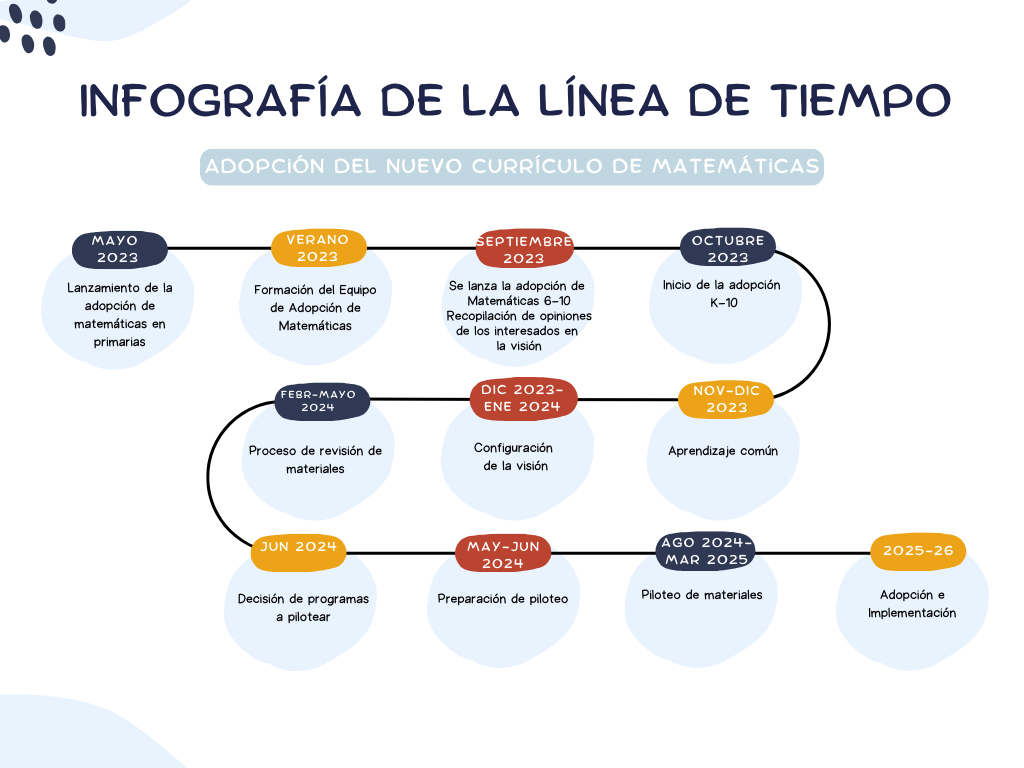
El equipo de adopción ha creado un vídeo que detalla el proceso de adopción y los paquetes curriculares que se están considerando. Están invitados a enviar comentarios mediante un formulario en línea después de ver el video.
ELA Curriculum Adoption Update
Eugene School District is excited to announce the newly adopted language arts curriculum for both middle school and high school. Oregon’s updated language arts standards emphasize foundational skills in all grades, building knowledge through content and text complexity as well as using evidence while writing and speaking to respond to both informational texts and literature.This comprehensive update is part of our ongoing commitment to providing the highest quality education for our students.
Both the middle school curriculum and high school curriculum have been carefully selected to ensure they meet the diverse needs of our student body, align with state standards, and promote equitable access to educational materials for every student. We believe these adoptions will enhance our instructional practices and better prepare our students for future academic and personal success.
You may learn more about the curriculum by going to the links below:
Middle school curriculum: Amplify ELA
High school curriculum: HMH Into Literature.
We are grateful for the support of our community as we continue to strive for excellence in education. You may view the video below for more details regarding the curriculum adoption process:
Actualización sobre la adopción de ELA en la escuela secundaria
Nos complace anunciar que nuestro distrito escolar ha adoptado un nuevo plan de estudios tanto para la escuela secundaria como para la preparatoria. Esta actualización completa en video es parte de nuestro compromiso continuo de proporcionar la educación de la más alta calidad para nuestros estudiantes.
El nuevo plan de estudios para la escuela secundaria es Amplify ELA, y el plan de estudios para la preparatoria es HMH Into Literature. Ambos han sido cuidadosamente seleccionados para garantizar que satisfacen las diversas necesidades de nuestro alumnado, se alinean con los estándares estatales y promueven el acceso equitativo a los materiales educativos para cada estudiante. Creemos que estas adopciones mejorarán nuestras prácticas de instrucción y prepararán mejor a nuestros estudiantes para el éxito académico y personal futuro.
Agradecemos el apoyo de nuestra comunidad mientras seguimos esforzándonos por la excelencia en la educación. Para obtener más información sobre el proceso de adopción de materiales curriculares o el plan de estudios, se puede ver el video a continuación.
Estándares y currículos
El Distrito Escolar de Eugene 4J adopta y sigue currículos alineados con los estándares establecidos por el Departamento de Educación de Oregon.
Los libros de texto y otros materiales de aprendizaje se eligen para maximizar el aprendizaje y el crecimiento de los estudiantes. Los currículos se seleccionan en un ciclo establecido por el Departamento de Educación de Oregón, aunque esto puede retrasarse, y se compran y/o adoptan según lo establecido en el estatuto de Oregón.
Comenzando con la adopción de Lectura/Artes del Lenguaje en 2006-07, el distrito ha estado avanzando hacia la adopción de currículos en todo el distrito, incluyendo la adopción del currículo de ciencias K-8 en el 2016, el currículo de ciencias para preparatorias en el 2017 y el currículo de matemáticas de primaria en el 2017.
Para conocer los últimos estándares curriculares del Departamento de Educación de Oregón, haga clic aquí.
Si tiene preguntas sobre algún currículo, llame al Departamento de Instrucción al 541-790-7550.
CALENDARIO DE ADOPCIÓN DE CURRÍCULOS (SEPTIEMBRE 2023)
Descripción general de la adopción del currículo para artes del lenguaje y estudios sociales (grados K-5)
Adopción del plan de estudios para estudios sociales (grados 6 a 12)
Adopción del plan de estudios para artes del lenguaje (grados 6 a 12)
Adopción del plan de estudios para la salud (grados 6 a 12)